

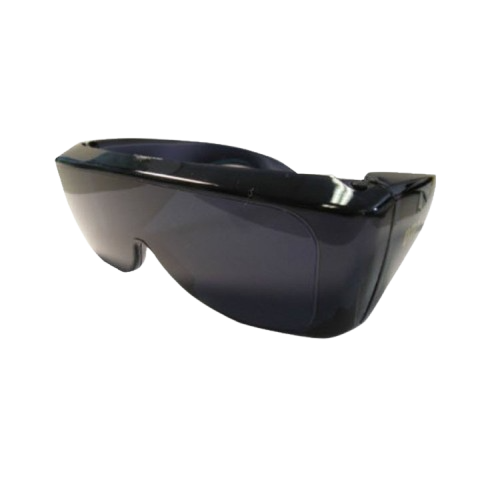
Safety Goggles
Safety first!
Tobrix places great importance on safe treatments. This applies, of course, to the patients being treated with our systems, but certainly also to the practitioners working with the lasers.
We therefore offer safety goggles for both patients and practitioners, ensuring thorough eye protection.
For practitioners, we have goggles available for all wavelengths (laser and IPL), and these goggles can be supplied in various fits.
In addition, we also have special patient goggles available.
Additional Information
We have eyeglasses available for, among others:
- 1064 nm/532 nm
- 755 nm
- 694 nm
- 10,600 nm
- 1540/1550 nm
- 2940 nm
- IPL
- 1940 nm
- 2100 nm
- 1470 nm
Please feel free to call or email us if you have any questions about the options available for a specific wavelength.
Related Products


FAQs
That’s certainly not the case!
Laser goggles are always designed for specific wavelengths (in nanometers, nm). In principle, glasses designed for a hair removal laser (e.g., Alexandrite 755 nm) do not protect your eyes from a CO2 laser (10,600 nm) or an ND:YAG laser (1,064 nm). So always check carefully beforehand to make sure your laser goggles are compatible with the wavelength of the laser system you’ll be using for treatment.
OD stands for Optical Density (Optical Density). This number—for example, OD5+ or OD7—indicates how much of the laser light is blocked by the lens.
The higher the number, the greater the protection.
VLT stands for the amount of visible light that the glasses transmit. Glasses with a low VLT (e.g., 20%) will make the surroundings appear very dark. A higher VLT (e.g., 60% or more) provides a brighter view during treatment.
Always handle laser glasses with care.
Clean the lenses only with a special eyeglass cleaner or mild soap and lukewarm water, then dry them with a microfiber cloth.
Never use alcohol or harsh disinfectants, as these can damage the special protective coating.
This depends on how the glasses are used. Check them regularly and replace laser safety glasses immediately if there are deep scratches, cracks, or discoloration on the lens, or if the frame is damaged.
Even a small scratch can drastically reduce laser safety (OD value).
In addition, it is recommended to regularly check laser safety glasses for material fatigue, especially with intensive use.