

What are vascular indications?
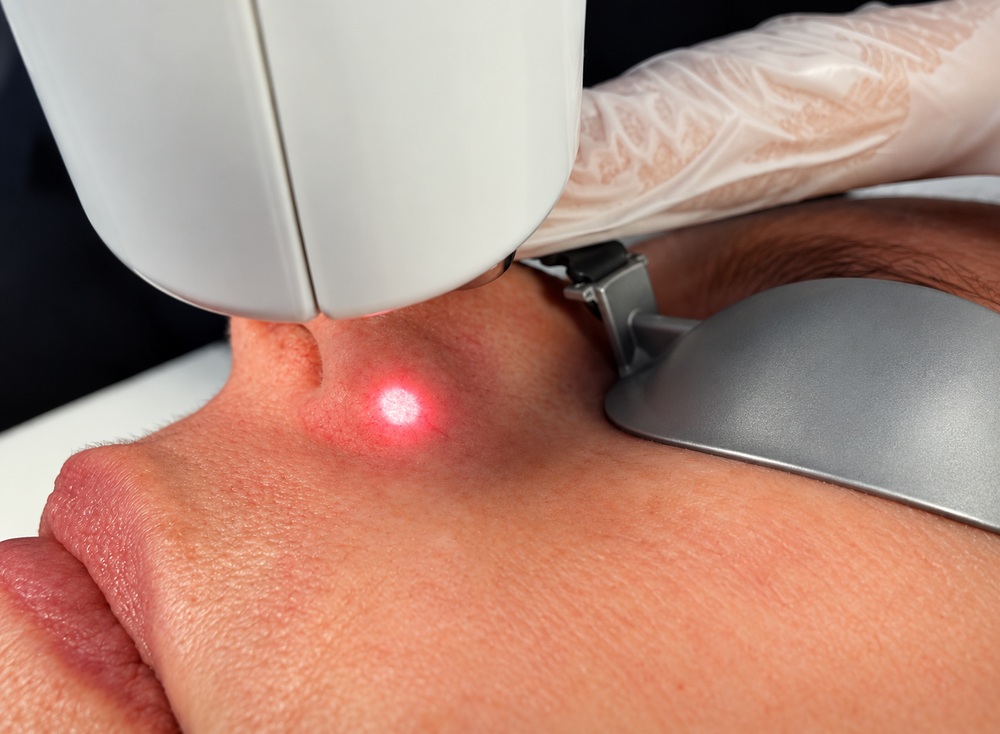
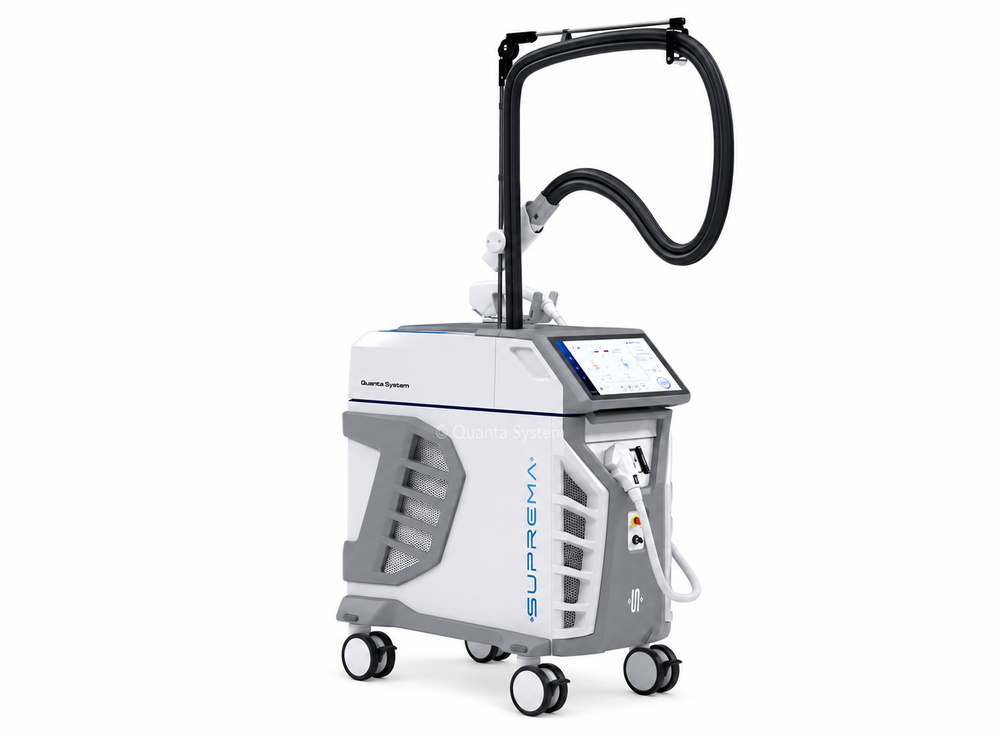
Spider veins, unsightly facial veins, rosacea, diffuse redness, etc., can be treated very effectively with laser and IPL. Tobrix offers a range of wavelengths and lasers suitable for treating these conditions, such as 1064 nm Nd:YAG, 532 nm KTP, and IPL on the Quanta System Suprema 4V MT or Duetto MT EVO.
Treatment
Vascular malformations—particularly couperose, spider veins, and rosacea—are likely the most commonly performed laser treatments after hair removal. Dermal vascular abnormalities have a number of characteristics that must be taken into account when selecting a laser:
- The diameter can range from almost invisibly thin to a few millimeters thick. The thicker vessels are found mainly on the legs; on the face, they are usually thinner.
- The color of a blood vessel is determined by the oxygen content of the blood. The higher the concentration of oxyhemoglobin in the blood, the redder the blood vessel. The higher the concentration of methemoglobin, the bluer the blood vessel.
- The depth depends on the type of vessel and its location. As a general rule, the vessels on the legs are deeper than those on the face, and the bluer vessels are deeper than the red ones. The diameter of a vessel must also be taken into account: the bottom of a thicker vessel is often deeper.
For the treatment of spider veins, Tobrix offers the Nd:YAG (1064 nm) and KTP (532 nm) lasers. In certain cases, IPL with a suitable filter can also be used.
Wavelengths
Nd:YAG is the “workhorse” among dermatological lasers and is also highly suitable for vascular applications. Nd:YAG is generally very powerful and is particularly well absorbed by methemoglobin. Absorption in oxyhemoglobin is less effective, but this is easily compensated for by the high fluences achievable with Nd:YAG. Nd:YAG is the only laser that is effective on blue leg veins. In this context, a relatively large spot diameter is important to reach sufficient depth.
KTP is absorbed very well by oxyhemoglobin. The advantage is that you can effectively treat small red vessels using very low fluences. KTP is produced by a crystal that halves the wavelength of Nd:YAG. This makes KTP a relatively cost-effective addition to an Nd:YAG laser.
IPL does not have a specific wavelength and is therefore not highly targeted toward a particular chromophore. IPL is very well suited for very thin blood vessels and diffuse redness, especially on the face and décolleté. These fine blood vessels do not require much energy to coagulate and are densely clustered over a larger area.
Pulse Duration
In addition to the specific properties of certain wavelengths, it is important that the laser used has a sufficiently wide pulse duration range. This is to make the best possible use of the difference in thermal relaxation time between blood vessels of various diameters and the skin. Thin blood vessels require a short(er) pulse duration to be treated effectively. Thick blood vessels can rupture if treated with a pulse duration that is too short and therefore require a longer pulse duration.
Spot Diameters
Another important factor is the spot diameter. At a given laser power, the fluence (J/cm²) decreases quadratically with the spot diameter. In other words, for the same fluence, a 6-mm spot requires 9 times as much laser energy as a 2-mm spot. Due to the scattering of laser light in the skin, larger spot diameters are needed to treat deeper blood vessels.
Quanta Mixed Technology®
A number of lasers on the market are capable of emitting two pulses with different wavelengths in rapid succession or simultaneously. This is the case, for example, with Quanta System lasers that feature Quanta Mixed Technology® and thus combine Alexandrite and Nd:YAG in a single laser.
In addition to the option of using Alexandrite and Nd:YAG separately, they can also be used in a single pulse: an Alexandrite pulse is followed by an Nd:YAG pulse. The Alexandrite pulse converts oxyhemoglobin into methemoglobin; the subsequent Nd:YAG pulse is then absorbed three (!) times more effectively and can achieve the desired result with less fluence. This technique combines the advantages of Alexandrite and Nd:YAG in terms of both effectiveness and safety.
In short…
The Nd:YAG laser will form the basis of a vascular laser treatment. In addition, you can expand the treatment with KTP 532 nm or IPL (diffuse redness), though you’ll need to carefully consider exactly which indications you want to treat. You can also consider the added value of KTP or IPL for other indications, such as pigmentation or acne.
Frequently Asked Questions About Vascular Treatments
During laser treatment, unwanted blood vessels on the face or legs, for example, are targeted. The laser emits a beam of light that is specifically absorbed by the (red) color in the blood. The heat from the laser causes the blood vessel to coagulate, after which the body naturally clears away the vessel.
Of course, the treatment is performed without damaging the surrounding skin.
Examples include (superficial) leg veins, veins around the nose, spider naevi, angiomas, or rosacea.
We offer the following systems for hair removal treatments:
(click on the system to learn more about the capabilities of that laser)
Quanta System Suprema
Quanta System Duetto MT EVO
Quanta System Thunder MT
Quanta System Light EVO
Quanta System Chrome
Lynton Excelight
Want to learn more about the treatment of vascular conditions?
Feel free to contact us if you have any questions about treatment options for vascular conditions.
We’d be happy to help!