

Tattoo Removal
With the increased popularity of tattoos in recent years, the need to remove them has also grown significantly. This has led to a growing demand for improved removal methods. There are now effective techniques available for removing tattoos that deliver good results with minimal damage to the skin.
Tattoo Removal Using a Q-Switched or Picosecond Laser
The best methods for removing tattoos are using a Q-switched laser or a picosecond laser. With the advent of picosecond lasers, tattoos can be treated with fewer sessions and with excellent results. The laser emits ultrashort, high-energy pulses. The energy from the laser pulses breaks up the ink particles, turning the ink into tiny, dust-like particles. This is what immediately sets it apart from other, less effective lasers: if the ink particles are not broken down into very small particles, the body is less able to break them down and eliminate them. As a result, fewer treatments are needed when using the picosecond laser.
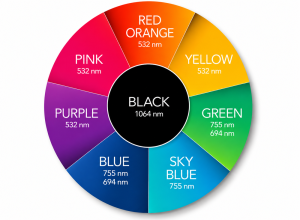
Our systems utilize the following wavelengths, which can remove virtually all ink colors. Here is a general overview:
1064 nm – black/dark blue ink
532 nm – red , orange, and certain shades of yellow ink
694 nm – ( light) blue and green ink
Picosecond Laser
The Quanta System Discovery PICO Plus is the most powerful picosecond laser in our product line.
This picosecond laser features three built-in wavelengths to remove tattoos of many different colors: 532 nm, 1064 nm, and 694 nm.
The Discovery PICO Plus has proven to be a highly versatile and robust laser, also for indications such as hyperpigmentation and skin rejuvenation.
Tobrix offers an extensive range of Q-switched, nanosecond, and picosecond lasers, with all wavelengths available. In all cases, these are high-power lasers suitable for long-term and intensive use. If you’d like to know which Q-switched or picosecond laser is best suited for your clinic, please contact us for a no-obligation consultation.
Frequently Asked Questions About Tattoo Removal
When removing a tattoo with a laser, the ink particles in the skin are broken down using very short, powerful pulses of light.
There are several laser techniques suitable for tattoo removal, namely the Q-switched laser (nanoseconds) and the picosecond laser.
The small pigment particles are gradually eliminated by the body through natural processes. As a result, the tattoo will fade more and more after several laser treatments.
How quickly this happens depends on several factors, such as the location of the tattoo, the ink used, and how long the tattoo has been on the body.
Both the Q-switched laser and the picosecond laser operate using very short pulses. Yet it is precisely that same pulse duration that sets the two technologies apart.
Q-switched technology operates in nanoseconds (one billionth of a second).
The powerful light pulses break the ink down into tiny particles without damaging the surrounding skin. The particles are then eliminated by the body.
A picosecond laser operates with even shorter pulse durations, in picoseconds (one trillionth of a second).
Due to these ultrashort pulses, the picosecond laser releases less heat into the skin but pulverizes the tattoo pigments into even smaller particles.
The body can clear these small particles even more easily and quickly.
Generally speaking, the following classification can be used:
1064 nm – black/dark blue ink
532 nm – red , orange, and certain shades of yellow ink
694 nm – ( light) blue and green ink
We offer the following systems for tattoo removal:
(click on the system to learn more about the capabilities of that laser)
Quanta System Discovery PICO Plus
Quanta System Q-Plus C EVO
Quanta System Chrome
Want to learn more about tattoo removal?
Feel free to contact us if you have any questions about tattoo removal options.
We’d be happy to help!