


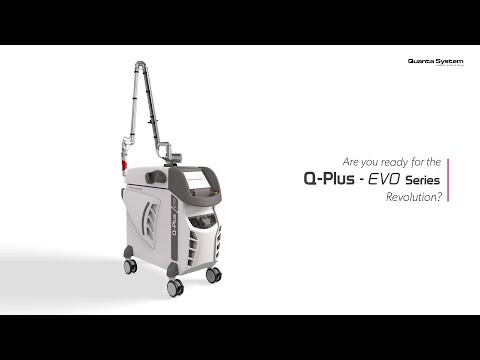
Quanta System Q-Plus C EVO
The Q-Plus C EVO has proven itself to be the ideal laser for tattoo removal. It is the only Q-switched laser with built-in Ruby (694 nm), Nd:YAG (1064 nm), and KTP (532 nm) lasers.
This laser is designed to remove tattoos of all colors and is also perfect for treating benign pigmented lesions and a wide range of other skin-improvement indications.
Additional Information
In addition to offering three laser sources— 1064 nm, 694 nm, and 532 nm —for removing tattoos of all colors, the Q-Plus C EVO has several other unique advantages. Because it uses solid-state lasers, it always delivers maximum power and requires no consumables, such as dye handpieces.
The Optibeam II handpieces are available with either a round or square spot. These handpieces produce a perfectly homogeneous spot for effective treatment with minimal skin damage. The spot remains the same size regardless of the distance from the skin. This makes treatment easier and eliminates the risk of damage from focused light.
In addition to the standard 6-ns Q-switched pulse, the Q-Plus C EVO features several other pulse modes. The Opti-Pulse divides the pulse into two short pulses with a pause in between. This mode is protective, especially for darker skin. The Thermal Pulse is suitable for, among other things, removing vellus hair and diffuse redness.
In addition to the standard handpieces, the Q-Plus C can also be equipped with two different fractional handpieces.
PlasmaFrax 8DF (deep fractional): a handpiece with a non-ablative effect for general skin rejuvenation and scar treatment. Depending on the selected settings, mild ablative treatment can be performed, accompanied by dermal remodeling. Downtime is shorter than with a CO2 laser, for example. In particular, the creation of LIOBs (laser-induced optical breakdown) produces the desired effect. This treatment can also be used for stubborn tattoos.
PhotoFrax 9HC (high coverage): handpiece for expanding pigment treatment options.
Like all EVO versions of Quanta System lasers, the Q-Plus C can also be equipped with an Er:YAG fractional handpiece (Twain 2940) and/or an IPL handpiece (Twain IPL).


FAQs
The Quanta System Q-Plus C EVO is a versatile Q-switched laser designed for various dermatological and aesthetic treatments, including pigment and tattoo removal.
The Q-Plus C EVO features three laser sources: the 1064 nm Nd:YAG, 532 nm KTP, and 694 nm Ruby.
The system uses powerful, ultrashort nanosecond pulses that are selectively absorbed by pigment or ink. This protects the surrounding tissue.
The square spots produced by the OptiBeam handpieces minimize the risk of overlap, hotspots, and skin damage.
Various models are available within the Q-Plus series. This makes it possible to choose a system that can be fully tailored to your desired treatments.
We’d be happy to advise you on which model best suits your practice.
- Tattoo Removal
- Treatment of Pigment Spots and Age Spots
- Skin Rejuvenation
- Treatment of (acne) scars
- Treatment of broken capillaries and redness
- PMU Removal
The specific treatment applications depend on the selected settings and the indication.
Q-switched technology uses very short laser pulses with high peak energy.
The laser’s energy targets the pigment, breaking it down into small particles.
The body can then eliminate these smaller pigment particles.
For this reason, Q-switched technology is widely used in tattoo removal and pigment treatments.
Both Q-switched lasers and picosecond lasers operate with very short pulses. Yet it is precisely that same pulse duration that sets the two technologies apart.
The Q-Plus C EVO features Q-switched technology and operates in nanoseconds (one billionth of a second).
The powerful light pulses break the ink into tiny particles without damaging the surrounding skin. The particles are then eliminated by the body.
A picosecond laser operates with even shorter pulse durations, in picoseconds (one trillionth of a second).
Because of these ultrashort pulses, the picosecond laser releases less heat into the skin but pulverizes pigments from tattoos or pigmented lesions into even smaller particles.
The body can clear these small particles more easily and quickly.
Which technology is most suitable depends, among other things, on the tattoo, the pigment, the color, and the desired treatment.
In addition to the standard Q-switched pulse, the Q-Plus C EVO also features additional pulse modes.
In Opti-Pulse mode, the energy of the laser pulse is divided into two equal pulses with a short pause
,
which reduces the thermal load on the skin.
You might choose this mode, for example, if you want to treat darker skin types more cautiously and minimize the risk of potential side effects such as hyperpigmentation.
In Thermal Pulse (or Photo Thermal) mode, the laser switches to a longer emission, extending the pulse to microseconds or milliseconds.
So there is no photoacoustic effect, but rather controlled heating.
This mode can also be effective for diffuse sun damage.
In addition to the handpieces included as standard, the Q-Plus series lasers can be upgraded with a (cooled) Twain IPL handpiece or a Twain 2940 nm Er:YAG handpiece.
The Q-Plus is equipped with an OptiBeam II handpiece. It is available with different spot shapes (round and square) and is designed to ensure a uniform distribution of energy across the treatment area. The Q-Plus C comes standard with square spots.
In addition to the standard handpieces, the Q-Plus C can also be equipped with two different fractional handpieces.
PlasmaFrax 8DF (deep fractional): a handpiece with a non-ablative effect for general skin rejuvenation and scar treatment. Depending on the selected settings, mild ablative treatment can be performed, accompanied by dermal remodeling. Downtime is shorter than, for example, with a CO2 laser. In particular, the creation of LIOBs (laser-induced optical breakdown) produces the desired effect. This handpiece can also be used for stubborn tattoo removal.
PhotoFrax 9HC (high coverage): handpiece for expanding the range of pigment treatments and scar treatments.
The Q-Plus C EVO is a Q-switched laser (nanosecond), and the Discovery PICO Plus is a picosecond laser. Our picosecond laser also offers nanosecond modes.
See “What is the difference between a Q-switched laser and a picosecond laser?” for an explanation.
Choosing a laser is a very personal decision, and every practitioner has different needs.
Tobrix is happy to help you determine which laser best suits your practice. Together, we’ll look at the treatments you want to offer your target audience, the appropriate options for these, and any potential future expansions.
You’re always welcome to stop by for a no-obligation consultation and a demo of the system!
At Tobrix, we value long-term partnerships, so our service doesn’t end once you’ve purchased the system.
Upon delivery of your new system, we will, of course, assist you with installation and training.
Together with our clinical trainer, we ensure that you receive thorough training so that you can make the best use of the laser.
Each year, we provide additional training—either in collaboration with Quanta System or independently—through webinars, meetings, and other formats.
The continuity of your practice depends largely on the technical condition of the laser. Service is an indispensable part of this.
Tobrix has its own service and maintenance department staffed by expert and certified professionals. They are available to answer your questions, provide technical support, and perform annual service.